
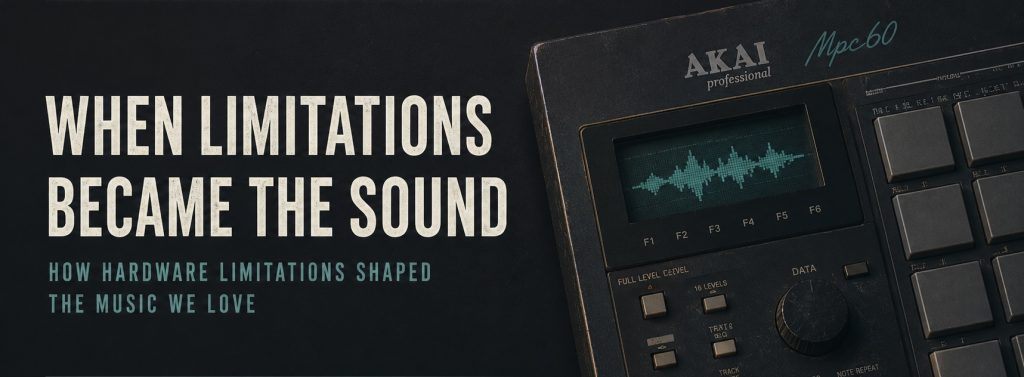
There’s something ironic happening in modern music production.
People are spending thousands on plugins, converters, saturation boxes and “analogue emulation” tools trying to recreate what old hardware used to do naturally, often by accident.
Back in the early jungle, hardcore and rave days, nobody was chasing “warmth.” Nobody was discussing transient integrity, oversampling modes or harmonic enhancement. Producers were working with whatever they could afford, whatever they could borrow, and whatever their hardware physically allowed them to do.
And somehow, hardware limitations in music production became the sound of an entire generation.
The Sound of Constraints
Early samplers were brutally limited:
- Tiny memory capacity
- Low sample rates
- Aggressive aliasing
- Crude pitch shifting
- Noisy converters
- Harsh digital clipping
But instead of avoiding those flaws, producers unknowingly turned them into character.
A chopped break sampled too hot into an Akai suddenly gained aggression. A pitched-up vocal became eerie and emotional because the algorithm was falling apart. Game console audio sampled through cheap circuitry created textures nobody could intentionally design.
The machines weren’t transparent.
They imposed themselves onto the music.
And that imprint became identity.
Jo – R-Type: A Perfect Example
Take Jo – R-Type, one of the most iconic jungle tracks ever made.
“The haunting lead riff is widely believed to have originated from audio found in the Game Boy version of R-Type…”,
sampled directly from the handheld console’s audio output. Whether entirely true or partially mythologised over time, the important thing is this:
The magic isn’t in pristine fidelity.
It’s in the crunch.
The grain.
The instability.
The texture created by limited technology being pushed beyond its intended use.
Today, producers spend hours trying to recreate those same imperfections with plugins and boutique hardware.
Back then, the imperfections came free with the machine.
From Technical Flaw to Premium Feature
What’s fascinating is how many things once considered “bad” are now sold as desirable:
- Converter clipping
- Tape saturation
- Aliasing
- Crosstalk
- Noise floor
- Pitch artifacts
- Non-linear distortion
Entire industries now exist around recreating these behaviours.
The irony is that engineers originally spent decades trying to eliminate them.
Modern digital audio is astonishingly clean, accurate and flexible, but sometimes that perfection removes the tension, unpredictability and emotional roughness that made older records feel alive.
Character Cannot Be Fully Simulated
You can model circuitry.
You can emulate harmonic response.
You can mimic frequency curves.
But recreating the mindset of working under limitation is much harder.
When producers only had seconds of sample time, every sound choice mattered.
When hardware distorted, they leaned into it.
When something sounded exciting, they used it, regardless of whether it was technically “correct.”
That raw decision-making process became part of the music itself.
And maybe that’s the real lesson:
The most iconic sounds in music history often came from people working around limitations, not avoiding them.
The Vinyl Connection
As a mastering engineer and vinyl cutter, I see/hear this every day.
The slight compression of a cutter head.
The way a stylus traces a groove.
The tiny compromises required to make music physically fit onto a record.
On paper, these are limitations.
In reality, they’re part of the reason people still connect with vinyl decades after digital audio solved many of these problems.
Sometimes perfection isn’t what people are looking for. Sometimes they’re looking for character.
People spend fortunes now trying to recreate what happened naturally through hardware limitations.
Dapz
